
New Jersey's City Directory Collections
New Jersey does not have one continuous statewide run. The New Jersey State Library bibliography identifies titles, publishers, years, and whether a copy is a rare book, fiche, reel, or held by a local library. That makes a New Jersey city directory search a title-and-year lookup: start with the place and publication year, then confirm the actual format and holder. These are documented holdings, not a promise that every year survives or that each volume is digitized.
| Collection | Years | Where Held | Access |
|---|---|---|---|
| Newark directories, including Pierson, Boyd, Holbrook, and Gopsill titles | Selected annual runs from 1835 through 1876 and later | State Library rare books, fiche, and reels; local copies are listed | Ask for the exact title and year; formats vary |
| Paterson and Passaic directories | 1855, 1857, 1859-1861, and 1868-1879 and later | State Library Seg I and II reels | Reference request or in-person use |
| Plainfield and North Plainfield directories | Selected years from 1879 through 1908 | Plainfield Public Library books and reels; State Library | Confirm the needed year with the holding library |
| Essex and Oranges directories | 1890, 1891, 1894-1897, and 1900 | Montclair Public Library reels and State Library segments | In-person holdings; ask about the exact reel |
| Jersey City and Hudson directories | Selected Library of Congress entries from 1932 through 1958, plus local runs | Jersey City Free Public Library New Jersey Room, State Library, and Library of Congress guide | Local-history inquiry or a request naming place and year |
The statewide list is a finding aid, so a title listed there still needs a repository check. A missing year in one library may exist on another reel or in a municipal collection. Publication dates also vary: a title can cover a year ending in the next calendar year, and the printed title page is the best record of its date range.
New Jersey's Newark Directory Run
Newark offers one of the clearest long sequences in the New Jersey evidence. The State Library bibliography lists B. T. Pierson volumes beginning with the 1835-36 directory and annual years through 1862, then Pierson for 1863-64, Gopsill for 1865-68, and Holbrook titles beginning in 1867. The entries overlap in some years because publishers and formats changed. Treat each printed title as its own dated source instead of merging the sequence into a made-up annual run.
Other Newark listings include Boyd's business and state volumes for 1857-60, followed by later commercial directories on reels. Those business volumes may answer a different question from an alphabetical household section. Record the publisher and section as well as the year, especially when a name appears at both a home and business address.
- 1835-36: B. T. Pierson's Newark directory begins the documented run.
- 1857-60: Boyd's business and state volumes appear alongside other Newark titles.
- 1865-68: Gopsill titles are listed, with Holbrook years beginning in 1867.
These milestones describe cataloged examples, not a complete publication history for every year or edition.
Use the State Library Finding Aid
The State Library's 71-page New Jersey City Directories at the New Jersey State Library bibliography is the most useful statewide locator for a specific volume. It records the city, title, year, publisher, and shelf, reel, or fiche location. Before planning a visit or request for a New Jersey city directory, note the exact title and format shown in the entry. A local library may hold a separate copy even when the statewide listing points to Trenton.
The New Jersey State Library directory bibliography is a finding list, not evidence that every listed volume can be read online.
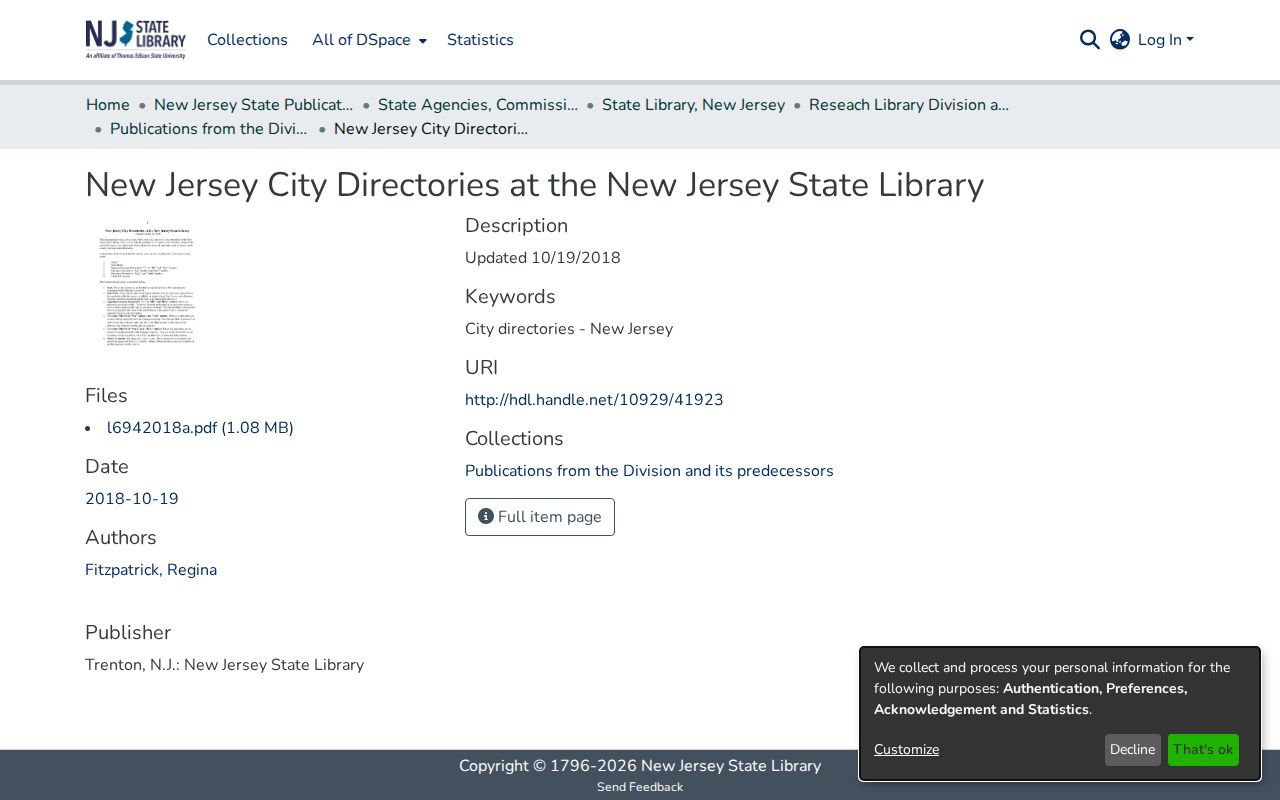
Use the entry to ask for one city, title, and year at a time. If a reel or book is not at the first repository, the bibliography can point toward another listed holding.
Note: Naming the title and year helps library staff distinguish a bound directory from a fiche or reel copy.
Reading New Jersey City Directory Entries
An alphabetical entry can combine a surname, given name or initial, occupation, employer or business, street address, and a household note. The layout depends on the publisher. A printed address is a strong lead for the next volume, but it does not establish ownership or prove that every member of a household was listed.
Inspect the front matter before drawing meaning from shorthand. Newark's nineteenth-century volumes may use marks such as “h” or “r,” widow notes, initials, or family names in parentheses. The same mark can vary across publishers, so copy the printed form and check that book's own key.
| Name | Surname and given name or initial in the alphabetical section |
|---|---|
| Occupation or business | Printed trade, occupation, employer, or business listing when supplied |
| Address | Street and number; a separate business address may also appear |
| Household or status mark | Spouse or family notation, widow abbreviation, or occupant-status mark when that edition uses one |
| Reference details | Publisher, title year, section, page, and the volume's abbreviation key |
- Criss-cross directory
- A street-order section that lists an address first and then the people or businesses printed at it. It is often paired with an alphabetical section.
- Householder index
- An alphabetical route to a person listed as the household head; it is not a full list of everyone living at the address.
- Abbreviation key
- The volume's own guide to shortened words and marks, usually in its front matter. Check it before interpreting “h,” “r,” or “wid.”
Keep a note of the exact spelling, punctuation, street direction, and page number. Those small details can help distinguish two people with similar names or connect an older address to a later street index.
Trace Households Across New Jersey Directory Years
Directories can fill time between census snapshots, but their publication date is not an exact count date. Start with a name or address already supported by a family record, deed, obituary, or census. Then record each directory appearance without assuming that a gap means a move or death.
- Write down the printed place, title, year, section, page, name, and address for the earliest useful entry.
- Search the next available year and note spelling, street number, household marks, and any listed family names.
- Use the street-order section to test an address when the alphabetical entry is uncertain.
- Compare a nearby federal census year, then check New Jersey state census material where it survives.
- Return to deeds or a map when the question is ownership, a changed street number, or a parcel boundary.
The federal census is public through 1950 under the 72-year release rule. New Jersey state censuses run from 1855 to 1915, though the 1865 and 1875 returns are incomplete in places and 1915 was the last state census. Census schedules describe a household at one point; directories can add intervening years, while deeds answer a different ownership question.
For a single address traced backward through owners and occupants, the New Jersey previous residents trail joins these collections to the deed chain.
Note: Record missing editions as gaps instead of treating the next available directory as an uninterrupted year-by-year account.
New Jersey Archives and Lost Deeds
The New Jersey State Archives is a fallback when a local shelf is incomplete, especially for land, census, probate, and court material. Its research collections include county deed microfilm through 1900, state and federal census material, and historical vital indexes. The State Archives recommends an appointment for in-person research; reference searches and reproductions may have different access and fees.
The Archives' genealogical collections index summarizes the historical series and their date coverage.
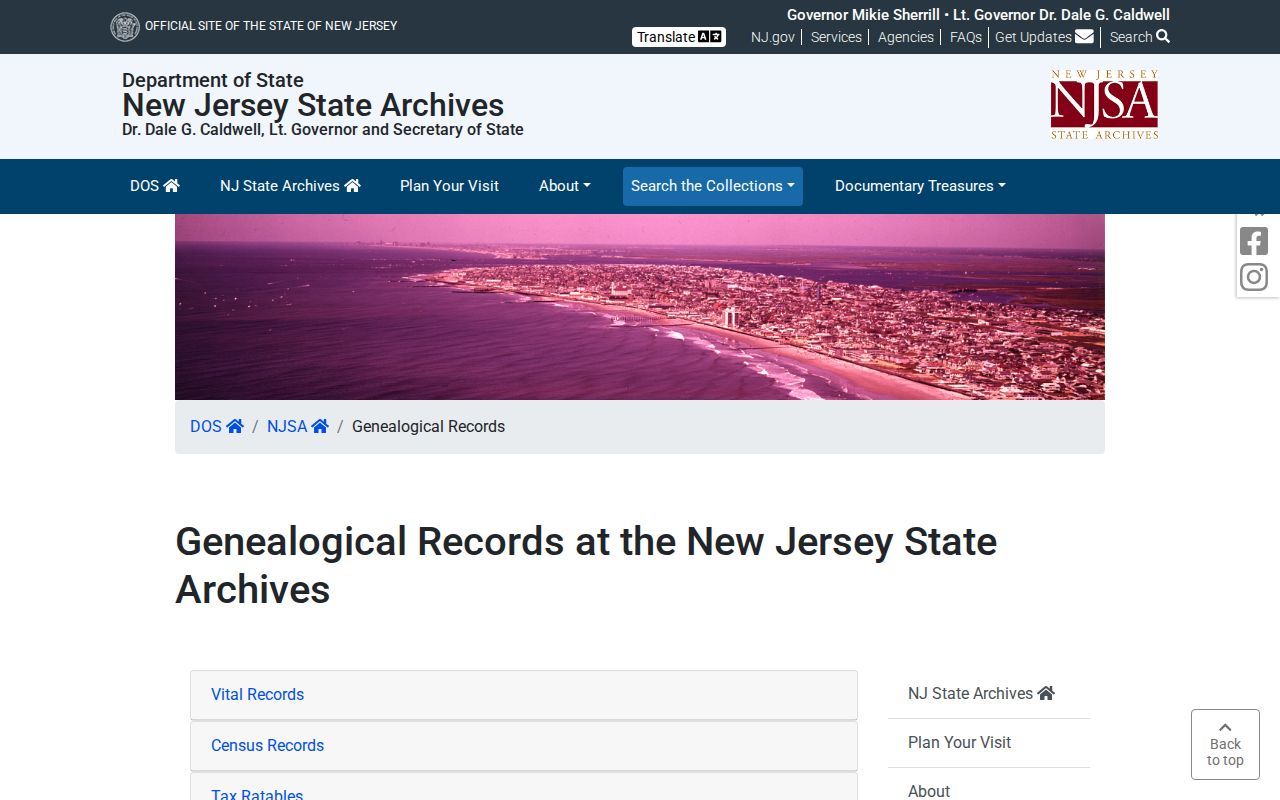
The index helps identify surviving records, but it does not promise a title for every New Jersey municipality or year. A State Library listing and a local library check remain important for the directory itself.
One unusual part of the land record history is the State Archives' collection of “lost deeds,” reconstructed by the New Jersey Supreme Court after the Revolutionary War. The Archives also preserves paper, microfilm, and reference aids, so an absent online scan does not mean the record never existed.
Digitized New Jersey City Directories Have Gaps
No complete, fully digitized statewide New Jersey city-directory run was located in the research. The Library of Congress guide routes readers to both digital and physical collections. Its holdings include specific Jersey City years and some county or city address directories, but the listed set is selective rather than a continuous statewide series. A New Jersey city directory title found online still needs a place and edition check.
The Library of Congress city and telephone directory guide describes collection routes and the information to include in a request.
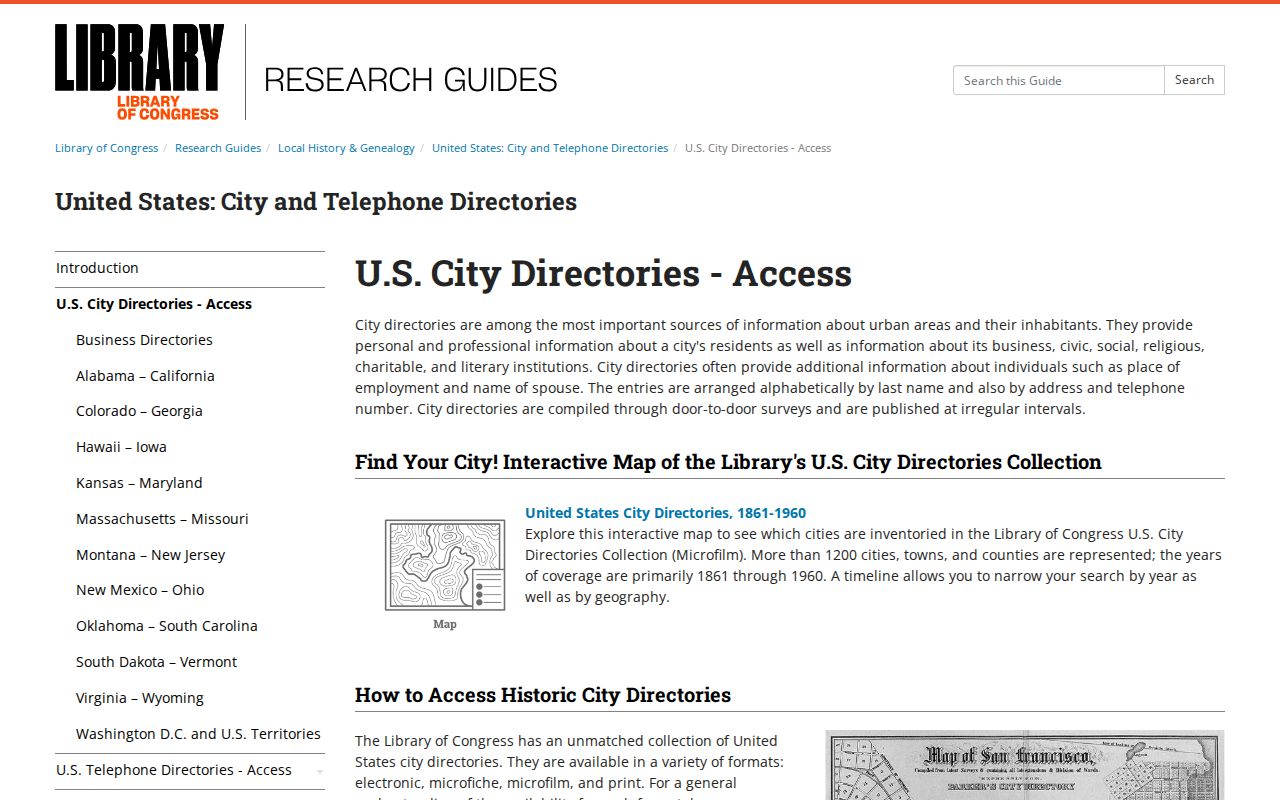
For an in-person or reference request, specify whether the need is an alphabetical directory, street-address section, or telephone directory, then name the place and year. FamilySearch availability varies by collection, and some images require a free account or access through a library or FamilySearch center.
Note: A search result that names a digitized collection should be checked for the exact city and edition before it is treated as a complete run.
New Jersey Newspapers and Directory Gaps
A directory is only one kind of historical source. The Library of Congress' Chronicling America browse set includes New Jersey newspaper titles with different places and year spans; it can help confirm an obituary, public notice, or address change. It is a digitized subset, not a complete newspaper archive. Local libraries and historical societies may hold later newspapers on microfilm or through licensed databases.
The New Jersey title list in Chronicling America lets a researcher check a newspaper's place and issue range. The State Archives' county historical resources directory can help route a question to an appropriate local organization; holdings vary by repository.
Ask the local public library's history desk about yearbooks, obituary indexes, telephone books, cemetery transcriptions, maps, and any local directory shelf. The State Library's genealogy and local-history service is another referral point. No statewide inventory confirms that each library has the same books, reels, or staff lookup service.
Limits of New Jersey Directory Evidence
A city directory can show that a name was printed at an address for a particular edition. It may also show a business address, spouse notation, or household mark. It is not a deed, a complete census of a building, or proof that the person owned the parcel. Confirm an ownership question in the county Clerk or Register of Deeds index, and use maps or block-and-lot descriptions when street numbering changes.
The New Jersey Historic Preservation Office's house-history method brings deeds, directories, atlases, archives, and courthouse sources together, and specifically treats directories as a way to verify deed research rather than replace it. For modern parcel details, county and municipal access depends on the address and local portal.
Preserve uncertainty in your notes: a same-name entry may refer to someone else, a missing volume can hide a move, and a street name may have changed. Follow the printed source, then compare the next independent record before drawing a conclusion.