
New Jersey Previous Residents by Record Era
One address can leave two different trails. Deeds and tax records connect legal ownership to a parcel, while directories and census schedules can place people at an address or within a household. The New Jersey record map is distributed among county, municipal, library, and State Archives collections. Its year ranges overlap, and none of these sources alone lists every person who ever lived at a property.
| Source | Years It Covers | Where Held | What It Shows |
|---|---|---|---|
| County deed records | Most county books begin about 1785 or at county creation; State Archives microfilm runs through 1900 | County Clerk or Register of Deeds; State Archives; FamilySearch availability varies | Recorded transfers, parties, and legal descriptions |
| State Archives early-land records | About 1650 through the 1900s; some early-land records extend through 1996 | New Jersey State Archives | Colonial and proprietary deeds, surveys, mortgages, and names |
| New Jersey city directories | Selected Newark years from 1835 onward; Paterson from 1855; Plainfield from 1879; other runs vary | State Library and local public libraries | Printed name, address, and household or business clues |
| Federal census | 1790-1950, public under the 72-year rule | National Archives, libraries, and FamilySearch | Household members and geographic context on census day |
| New Jersey state census | 1855-1915; 1865 and 1875 are incomplete in places | State Archives and digitized indexes | Household and state population context |
| Permits and code records | Municipality-specific; no statewide start year located | Municipal construction or code office | Address, work description, applicant, and date when retained |
| Sanborn maps and historic atlases | Town-specific editions; check the library catalog | Library of Congress and local libraries | Building footprint, street number, materials, and neighborhood change |
| Probate and estate records | State Archives wills and inventories from 1670-1952; current county files vary | State Archives and county Surrogate | Estate, fiduciary, heir, and property clues, subject to restrictions |
Start with a deed when the question is who held title, and with a directory or census when the question is who was listed in a household. The previous residents of an address are reconstructed by comparing sources, not by treating an owner name as an occupant list. Keep the owner chain and occupant timeline separate when tracing previous residents.
Resolve New Jersey Past Residents' Addresses
Before tracing a name, establish the physical municipality and county. New Jersey has 564 municipalities, while a postal city and ZIP may point to a different place. The official municipality search and county directory help route the address to the right local assessor and County Clerk or Register of Deeds.
Street names can be renamed, extended across a municipal line, or numbered differently over time. NJGIN address points include alternate street-name fields and are updated monthly, but there is no statewide historical renumbering list. Older directories, street indexes, atlases, local ordinances, and a parcel's block and lot can bridge a changed address.
Condominiums, apartment subaddresses, rural routes, and multiple address points on one tax lot can also frustrate a simple street search. Keep the current address, historic spelling, municipality, county, and legal parcel description in separate notes. A postal label is useful for delivery, but it does not settle which government office holds the record.
Note: Save the municipality and county with each result, since the same street name can appear on both sides of a local boundary.
Trace New Jersey Deeds Backward
County land records are not managed through one statewide deed portal. New Jersey uses a County Clerk in most counties and a Register of Deeds or County Register in Bergen, Camden, Essex, Hudson, Middlesex, Passaic, and Union. Search fields and online image cutoffs vary by county, so the address must be routed to its county before the index can be used.
Begin with the current parcel record, but do not read its owner field as proof of who occupies the address. The statewide Property Explorer summarizes parcel data; local municipal assessor records may supply details omitted from statewide GIS, where owner names can be redacted under Daniel's Law.
- Record the parcel's county, municipality, block, lot, qualifier, assessment year, and legal description from the assessor source.
- Find the current owner's purchase deed in that county's Clerk or Register index, searching name variants and the party role.
- Note the recording date, document number or book and page, grantor, grantee, and legal description from the result.
- Search the seller as grantee in an earlier period, then follow the next seller backward through the prior deed.
- Stop when the online index ends and move to a courthouse terminal, older index book, or State Archives microfilm.
- Grantor and grantee
- The grantor gives or transfers an interest; the grantee receives it. In a deed chain, a prior seller is often the grantee on an earlier deed.
- Chain of title
- The sequence of recorded transfers that links one owner of a parcel to earlier owners.
- Legal description
- The parcel's formal land identifier, such as municipality, block, lot, qualifier, or metes-and-bounds wording. It can remain useful when a street number changes.
- Criss-cross directory
- A street-order directory section that starts with the address and lists the names or businesses printed there, rather than starting with a person's name.
- Enumeration district
- A geographic area assigned to a census taker; its boundaries may not match a modern street address.
Trusts, estates, corporations, family transfers, and multiple parcels can interrupt a simple name-to-name chain. Confirm each deed's legal description before treating it as the next step for the same property.
Bridge Gaps in New Jersey County Indexes
A county website may expose an index, images, both, or neither for older years. New Jersey has no statewide online cutoff date for deeds, and one county's search range must not be applied to the other twenty. In-person county terminals can show older books, indexes, or scans that the public website omits. Ask the county Clerk or Register which books and map records are available at the counter.
The State Archives genealogy collections include microfilm copies of all county deeds through 1900; county originals generally begin around 1785 or when that county was created. The State Library and local libraries can help locate directory, map, or local-history holdings. FamilySearch has digitized some county deeds, but the available title and image access vary by collection, and some images require a free account or library or FamilySearch-center access.
When a record is held by a public agency and no search interface is available, a targeted OPRA request may be appropriate. Send it to the agency's designated records custodian and identify the existing deed index, parcel, name, record type, and date range. OPRA is not a way to make a county create a new historical list, and the correct form and access route depend on the custodian. Check the current state guidance before filing.
Note: An online search ending at a particular year marks a portal limit, not the end of the property's recorded history.
New Jersey's Reconstructed Lost Deeds
Some New Jersey land records have an unusual post-Revolution history. The State Archives preserves “lost deeds” reconstructed by the New Jersey Supreme Court after the war, alongside early records whose originals remain with counties. Colonial and proprietary land records can predate the municipality name now attached to an address, so an older property trail may begin in a different jurisdiction or use an earlier place description.
State Archives collections reach back to New Jersey's colonial government in 1664. County deed books generally begin about 1785 or at a county's creation, while Bergen and Monmouth have earlier deed records. These are broad historical guideposts, not guarantees that a specific parcel has an unbroken chain or that every early source is indexed online.
When an early deed refers to a survey, tract, or predecessor place, compare the formal description with historic maps and later county books. Keep the source title, date, parties, and reference number together. The aim is to show how the property description changes across records without filling missing links by guesswork.
Follow New Jersey Previous Residents Through Directories
Directories add a household layer beside the deed chain. New Jersey holdings include Newark titles beginning in 1835-36, selected Paterson years from 1855, and Plainfield runs beginning in 1879. The New Jersey State Library bibliography and local libraries identify the actual books, reels, and fiche. Each title has its own coverage gaps, so a listed run should not be treated as an annual statewide census.
The New Jersey city directory collections explain how to locate a title, distinguish alphabetical and street sections, and read the volume's own abbreviation key. For a one-address history, use the street entry as a lead, then compare names and household notes across nearby available years.
A directory name is evidence that a person was printed at an address for that edition. It does not prove that person owned the property, and it may leave out household members. Compare the directory with the recorded deed and census rather than asking one source to answer both questions. This comparison builds a history of previous residents, not a shortcut to a complete list. Previous residents can be represented differently from one directory year to another.
Pair New Jersey Directories With Census Years
Federal census schedules provide a household snapshot, while city directories can fill some of the years between censuses. The public federal census now reaches 1950 under the 72-year rule. New Jersey state censuses were taken from 1855 through 1915; the 1865 and 1875 returns are incomplete in places, and 1915 was the last state census.
- Choose a known name, address, or family relationship and note its source.
- Find the closest available directory year and copy the printed name, address, household mark, title, and page.
- Compare the name and household with the nearest federal census year, then check a surviving state census where it fits.
- Repeat with the next available directory rather than assuming a missing edition represents a move.
- Use deeds for ownership and maps for a changed street number; census and directory entries are not title records.
For the same person, compare more than a surname. An address, spouse or family note, age, occupation, and neighborhood can help distinguish people with common names. Census geography may be an enumeration district rather than a modern street number, so a match should rest on several details and the source dates.
Note: A directory year describes the edition's publication period, not a guaranteed date when every listed household was observed.
New Jersey House History for Past Residents
The New Jersey Historic Preservation Office's house-history workflow recommends combining deeds, directories, atlases, archives, and courthouse sources. A directory may be arranged by surname or by address and can add printed address and occupation details, while an atlas or Sanborn map can show a building footprint, street layout, or neighborhood change. Map editions are town-specific; check the Library of Congress or a local library catalog for the place and year.
Municipal permits and code files may add build, addition, repair, conversion, demolition, or certificate-of-occupancy dates. There is no statewide start year for those files. Ask the municipality's construction or code office whether its records can be searched online, viewed in person, or requested through its OPRA custodian.
Dates from different sources answer different questions. An assessor's “year built” is an estimate or field value, not a deed date. A permit date records a government action, and a directory appearance shows that a name was printed. Together, these records can narrow a timeline while keeping ownership, occupancy, and construction distinct.
Close a New Jersey Family Trail
Obituaries, cemetery indexes, and probate records can help explain where a listed household went next. The State Archives historical vital collections include births through 1925 and marriages and deaths through 1950, with historical indexes for selected years. Current certified vital copies have eligibility limits, so an archival index or genealogy certification is not the same as an identity document.
County Surrogates handle wills, administrations, guardianships, and probate applications. Older surrogate books are often on State Archives microfilm through about 1900, with a Morris County exception in the Archives guidance. Probate may name heirs, fiduciaries, dates, or property, but protected details can be withheld. Check whether the county offers a name index or in-person search before assuming a file is online.
Using directories, census schedules, and probate together can help with a family history or heir question. Keep the source trail visible, and avoid joining records just because a name matches. A lawful personal history search should not become a reason to track, pressure, or harass a living person.
Lawful personal use. Research an address for family, property, or local history. Do not use names or addresses to track, threaten, harass, or harm anyone.
New Jersey Former Addresses and Previous Residents
The New Jersey Unclaimed Property Administration lets a researcher search current, former, or maiden names. A former address may help corroborate an heir or past-resident connection, but the state search is not a residence-history service and does not show who lived at a property. The claim process requires proof of ownership, and the state says searching and claiming are free.
The New Jersey unclaimed-property search is a limited lead when a name or family relationship is already known. A result can place previous residents in a family trail, but it remains an asset clue rather than an occupancy record.
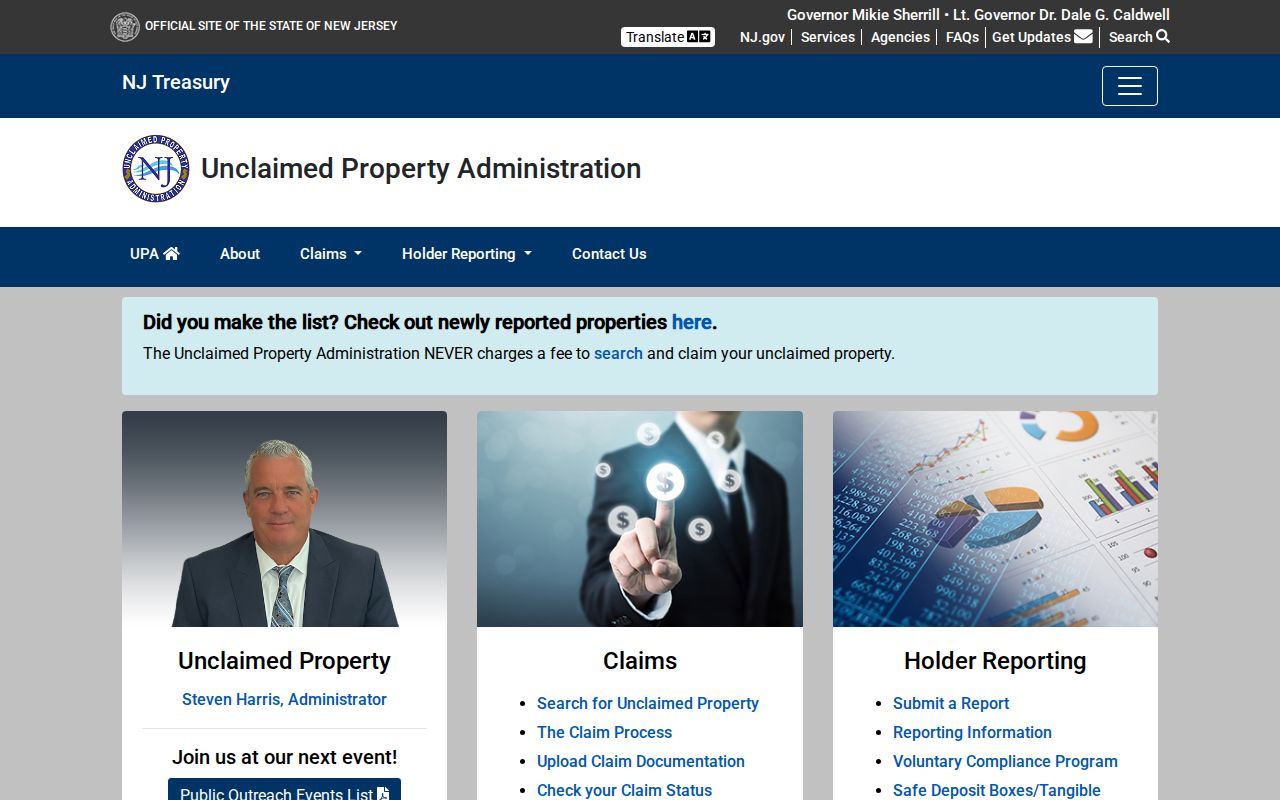
This clue can point toward a dormant asset or a relative's claim. It is not a residence record, an address lookup, or proof that a person occupied the parcel.
Note: The state tool is free to search and claim; its result supports an ownership claim only when the required documents are supplied.