
How to Find New Jersey Residents
Start with the record that fits the question. A name tied to a county points toward court, probate, voter-status, or license records. An address points first to an assessment roll and parcel map, then to a deed index if ownership matters. A family-history question belongs with older vital indexes, directories, census records, and local newspapers. The New Jersey residents directory is a map to those separate sources, not one complete roll kept by a single office.
Public files have clear edges. A deed records owners and transfers, not every occupant. A voter record covers registered voters and can be withheld or altered for privacy. A city directory reflects its printed year, while current vital records have access rules. Match more than one detail and keep the date and source with each note.
- Write the person's full name and any known town, county, former name, or time period.
- Resolve the municipality and county before choosing the assessor, clerk, or election office.
- Use the right index for the question, such as an individual status check, court case search, or historical vital record.
- Check an independent source, then ask the custodian about a counter, archive, mail, or OPRA route if the web search ends.
New Jersey Resident Records Offices
New Jersey records are split between central agencies and local custodians. The State Archives is the main stop for older land, vital, probate, census, and court series. NJDOH handles current statewide vital-record orders, and county election offices keep voter files. Each county Clerk or Register controls its own deed index; municipal assessors hold the annual parcel list. The address trail moves between these offices rather than through one statewide resident database.
New Jersey State Archives
225 West State Street
Trenton, NJ
609-292-6260
Archives Research Center
NJ Vital Statistics
140 East Front Street
Trenton, NJ
Phone vendor: 1-877-622-7549
County Election Offices
Commissioner of Registration or Superintendent of Elections
Contact varies by county
State voter hotline: 1-877-658-6837
Route New Jersey Records by County
There are 21 counties, and their land-record offices do not all use the same title. Bergen, Camden, Essex, Hudson, Middlesex, Passaic, and Union use a County Register; most others use a County Clerk. County Surrogates handle probate and estate records, while the municipality keeps permits, local vital records, and many code files. Start with the official county directory to locate the right clerk or register for a specific address.
The New Jersey county directory lists county seats, addresses, phone numbers, websites, and clerk links. It helps route a resident records request without assuming that the postal city names the correct county.
The state's county directory shows the county-level route behind a New Jersey resident search. Confirm the municipality as well, since county offices do not hold every local permit or tax card.
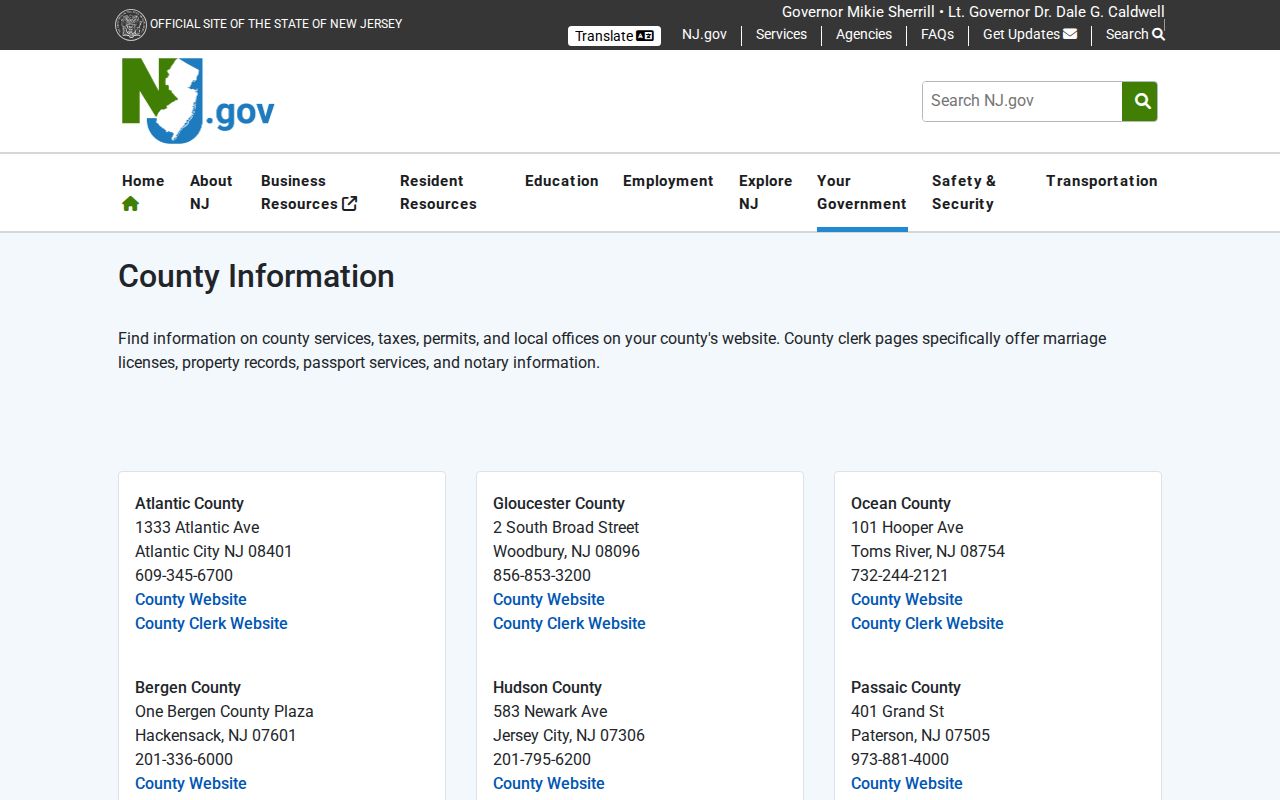
Once the municipality and county are clear, use the local office's own access page for coverage years, fees, and copy rules. Those details differ from one county to the next.
New Jersey Parcel Search Fields
The New Jersey Property Explorer presents mapped parcel information and yearly assessment details. A search may combine county, municipality, street address, block, and lot. Those are not interchangeable keys: municipality protects against postal-city confusion, while block and lot identify the legal tax parcel. The public map can help locate land even where a hosted owner name is redacted.
| Field | Entry type | How it helps |
|---|---|---|
| County | Selection | Routes the search to one county's parcel set |
| Municipality | Text or selection | Separates a legal town from the postal city name |
| Street address | Text | Searches for a site address; a partial street can return more results |
| Block and lot | Text fields | Provides the parcel key; qualifier conventions are local |
| Assessment year | Year or list | Shows which annual tax list is represented |
The state page says lists are filed each January, so a later transfer may not yet appear. NJGIN explains that hosted owner names can be redacted under Daniel's Law, P.L. 2020, c.125. Use the parcel key to ask the local assessor or county Clerk/Register for the next record. The complete address-to-deed chain belongs to a separate street-by-street workflow.
New Jersey Voter Status Is Narrow
The state's “Am I Registered?” check is for an individual voter who wants to confirm status. It is not an open name-to-address directory. County registration offices keep broader records, and election statutes, OPRA, and privacy rules decide what fields can be released. A public status hit confirms a registration result on the search date, not daily occupancy.
For a permitted county file request, identify the county, record date, specific fields, format, and purpose. Ask for the office's own form and current fee. Voter signatures, Social Security numbers, driver's-license numbers, and non-driver ID numbers are protected. Ballot choices are never part of a resident search.
Use the individual status tool for that limited check, then use the Division of Elections contact details above to reach county officials.
New Jersey Court Results Need Context
The New Jersey Superior Court public case jacket can be searched by party name, docket number, or judgment. A party-name search asks for a case division, county or venue, and individual or business name. Search results may show name, venue, docket number, caption, and case initiation date. The case jacket can show status and disposition, but access to filings depends on the case type and record.
Use a county or vicinage to narrow common names, then read the party role and outcome. Sealed, expunged, juvenile, adoption, and many confidential family records do not appear as ordinary public results. For federal matters, the District of New Jersey uses PACER; municipal matters route through local court staff. A name hit is only an index lead.
The Judiciary's civil division page routes users to public access. Its case-jacket training guide shows the docket, party, and judgment tabs and the fields a result may contain.
New Jersey Vital Records Have Rules
The New Jersey Department of Health and local registrars keep birth, marriage, death, civil-union, and domestic-partnership records. The State Archives holds older series: births from 1848 through 1925 and marriages and deaths from 1848 through 1950. Searchable marriage and death indexes cover 1848 through 1900. Those dates describe archival holdings, not automatic eligibility for every copy.
NJDOH separates an informational genealogy certification from a certified copy. The state lists an initial $25 search and one copy or certification, $2 for each same-order additional copy, and $1 per extra genealogy year searched. Local fees vary. Current certified records can require proof of identity and a qualifying relationship or court order.
Order through the state online vendor, by mail, at the Trenton walk-in counter, through the phone vendor, or through the local registrar for the event town. Direct state mail, a vendor, and a local office may give different processing estimates. See the NJDOH order instructions and its fee schedule before sending papers or payment.
New Jersey License and Business Records
Some state records verify a credential or an organizational link rather than a residence. The Consumer Affairs License Verification offers person and business searches, with fields such as name, license number, profession, type, status, city, and state. NJEdCert offers a public educator-license lookup with active or inactive status.
The Treasury's Business Records Service can show entity status, registered agent, officers or members, business address, annual reports, and filed documents. A county Clerk or Register may keep a separate trade-name filing, so a business name search alone may miss a county record. Copy and status transactions can have fees.
The New Jersey Unclaimed Property Administration has a free search by current, former, or maiden name. A former address can help confirm a claim, but a search result is not proof of present residence. The state says search and claim are free; proof is needed to claim property.
When New Jersey Resident Records End
Online coverage is not even across New Jersey. County deed systems differ in their search fields, image fees, and earliest online date. A courthouse terminal may expose older books or indexes that a public web portal leaves out. Ask the County Clerk or Register whether in-person books, maps, tax-sale files, or archived indexes remain available.
The State Archives is open for free research, with appointments preferred and walk-ins when space allows. Its holdings include county deed microfilm through 1900, historical vital indexes, wills, census schedules, naturalizations, military records, and court files. The Archives also takes mail requests and charges for copies or reproduction. Contact reference staff before traveling if the year or collection is uncertain.
A focused request under the New Jersey Open Public Records Act, N.J.S.A. 47:1A-1 et seq., should name an existing record, custodian, date range, and format. The general deadline for an available record is no later than seven business days; fees and exemptions vary. The Government Records Council guidance explains request and appeal steps. Local libraries and historical societies can fill gaps with microfilm, newspaper indexes, and directories.
New Jersey Custody Records Are Separate
The New Jersey Department of Corrections routes users to its custody search and explains how to ask about parole records. That tool answers a narrow custody question; it does not work as a general resident directory. County jails keep separate systems, and New Jersey has no single county-jail roster for all 21 counties.
The NJDOC offender information page is the official route to the custody search. Its location here marks the edge of a statewide name search, not a shortcut around county, court, or privacy rules.
The official routing page links the New Jersey custody lookup and parole-record request path. The search can change over time, so verify any result with the agency that holds the record.
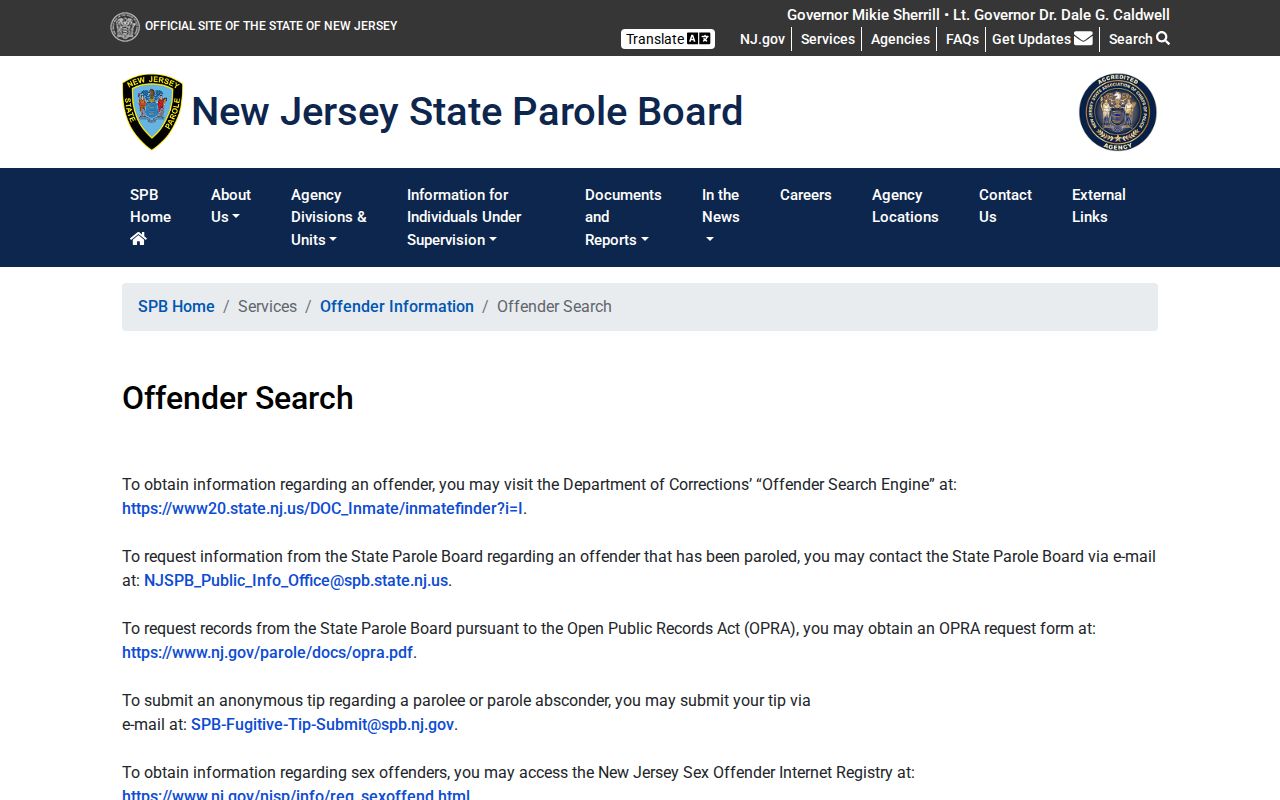
Do not use an absence from a custody tool to infer that a person has no court record or no connection to a town. Each public system has its own scope.
Current New Jersey Residents Directory Sources
Today's New Jersey resident records sit in separate systems, each with a narrow field of view. A useful directory starts by saying who is represented and who is left out. Ownership files do not name every occupant, voter data does not represent every person, and civic or business lists may be voluntary. Use the right source for the question and follow its access terms.
| Source | Who It Lists | Keeper | Access |
|---|---|---|---|
| Property Explorer | Mapped parcels, assessments, and selected owner fields | NJ Treasury and local assessor | Public map; local detail varies |
| Voter status | An individual's registration status | Division of Elections and county offices | Individual check; file requests restricted by rules |
| Deed index | Recorded property parties and documents | County Clerk or Register | County portal, counter, or request |
| License and entity records | Credential holders and business contacts | NJ DCA or Treasury | Public verification; some documents carry fees |
| Historic directories | People and businesses listed for a print year | State Library and local libraries | Holdings vary by title and year |
| Civic group pages | Published contacts or meeting details | Municipalities and voluntary groups | No statewide membership roster |
For one person, compare the record type with the fact it can establish. The New Jersey residents directory works best when a result is checked with its custodian instead of copied from a summary site. For a full street-address chain, use the street-level parcel and deed method, not this statewide overview.
New Jersey Resident Records Follow Local Geography
New Jersey has 21 counties and 564 municipalities, but a mailing label can name a different city from the legal town or county. The same street name may cross a town line. Before searching, resolve the physical municipality, postal city, county, and ZIP as separate fields. This step keeps a resident lookup from landing at the wrong assessor or clerk.
The county directory routes to county offices; the state's municipality finder resolves local government; USPS helps check the delivery city and ZIP. For an emergency-services address, the state's NG911 rules place address-point and road-centerline duties across county and municipal levels. Those address files normalize location, but they are not resident rolls.
New Jersey's land, shore, and suburban records also look different. A shore postal place can span a borough and township; a rural address may use a route or post office box; an older city street may have alternate names. Keep block and lot with an address when the map or deed calls for it.
New Jersey Addresses Need Privacy Checks
The state Address Confidentiality Program, N.J.S.A. 47:4-1 et seq., serves qualifying survivors of domestic violence, stalking, and sexual violence, along with reproductive-health patients and providers. It supplies a substitute address and mail forwarding for new records; it cannot erase a physical address already recorded. A protected address may be absent or replaced by design.
New Jersey's Daniel's Law, P.L. 2020, c.125, also leads NJGIN to redact certain owner names from hosted parcel data. Federal law restricts access to motor-vehicle address information. A public record can still have exemptions or redactions, and an OPRA request does not open a sealed, juvenile, adoption, or other restricted file.
Lawful use. Use New Jersey records for personal, lawful research. Do not use an address to stalk, harass, intimidate, or harm a person.
Trace New Jersey Family and Estate Links
For family history, pair a probate file with an obituary or recorded deed instead of treating a single name as a full family record. A county Surrogate can point to wills, administrations, guardianships, and estate filings. New Jersey State Archives holds historical county surrogate books and wills, while current county records stay with the local office. Ask for the estate number, book and page, or approximate year if one is known.
New Jersey's State Library and local libraries add directories, newspapers, cemetery transcriptions, yearbooks, and obituary indexes. A former classmate may appear in a school annual or local paper; a family link may appear in an archive's historical index. Access varies by collection, and a current vital copy still follows NJDOH's eligibility rules.
One practical route is name → obituary or directory entry → probate index → deed recorded by an estate. Each arrow is a lead to verify, not a guarantee that the same person appears in every record.
Historical New Jersey Resident Directories
Old New Jersey city directories can connect a surname, occupation, business, and street for one printed year. The State Library's 71-page bibliography identifies place, title, publisher, year, and whether an item sits in a rare-book collection, reel, or fiche. It is a finding aid; it does not mean each book is digitized.
Newark has documented runs beginning in 1835–36, followed by titles from Pierson, Boyd, Holbrook, Gopsill, and later publishers. Paterson directories begin in the 1850s, and Plainfield runs begin in the late 1870s. For the holdings and how to read an entry, use the New Jersey city directory collections.
New Jersey Lost Deeds Rebuilt Trails
New Jersey State Archives preserves “lost deeds” reconstructed by the state Supreme Court after the Revolution, along with colonial East and West Jersey land records. These files matter when a modern parcel's paper trail reaches earlier than the county deed book or the town's later street grid.
The State Archives holds microfilm copies of county deeds through 1900, while the original books remain with the county Clerk or Register. Some county records have also moved into archival custody, and digitized images vary by FamilySearch collection. A deed may follow ownership and legal description; it does not name every resident who once lived at the site.
For a New Jersey residents directory search that reaches far back, write down the exact collection, county, block and lot, and source date. This small trail note helps an archivist or county clerk find the next record without guessing which town or book you meant.